Jimmy Goes Gastric is all about the journey that my husband (Jimmy) and I are taking through his weight loss surgery process both before and after. It is our goal to provide accurate, first hand information about weight loss surgery, the weight loss experience, and what it is like to go through this as a family. We hope that you will join us as we begin this experience and feel free to add your thoughts, questions, suggestions and comments. Join us as Jimmy Goes Gastric!
Unless you are still in school, on disability or in between jobs right now you know what it's like to go to work on a regular basis. You probably also know how good or bad employers can be about allowing you to take time off of work. That's why it is important for you to carefully think things through when considering whether or not to do a weight loss surgery (WLS).
WLS effects more than just your body. It effects your emotions, your mind, your family/relationships, your job and so much more. If you are going to do a wls you need to realize that your near future includes many trips to the doctors office along with various medical tests and expenses. You have to be prepared.
One of the biggest areas of preparedness is your job. It's important to know your rights and to keep communication lines open between you and your employer. When I was hired at the St. Joseph News-Press, I was open with my potential employer about the hours that I would be taking off so that I could attend doctors appointments with my husband and the hours I would take off when he finally has his surgery. They were okay with my choices and appreciated my honesty. I know that not everyone has a job like that. That's why it's important for you to know about things like the Family Medical Leave Act (FMLA). Admittedly I don't know how best to explain it but you can learn more by talking to your companies human resources person and/or by visiting The Department of Labor Website.
No matter how easy or difficult your employer is to work with it is important to let them know how much time off you need, when you need it, and what they will be able to expect from you once your doctor clears you to come back to work after surgery. So get down to business and make a visit to your HR department. You need to know what you are getting yourself into before you dive into the deep end!
As I mentioned last post, we have Blue Cross/Blue Shield (BCBS) Insurance. I was going to tag all of this onto the last post and then I decided it would just be too much and more than a little overwhelming. Sorry to make you wait for it but rest assured that now you will get a more thorough answer to the insurance question.
Keep in mind that insurance coverage and requirements vary widely from one policy to the next. However, this is what Jimmy and I have been going through with BCBS. *Side note: I know that I haven’t mentioned this yet but we had considered WLS once before--about two years ago--and we had gone all the way through getting the insurance pre-approval before we backed out (due to circumstances beyond our control). So it was really nice to know basically what was going to be expected of us this time around which is why I think you will appreciate me sharing it with you*
The items below are the minimum necessary for approval of your weight loss surgery:
BMI of 40 or greater OR...
a BMI of 35 or greater with at least 2 co-morbidities.
*A Co-Morbidity is a disease that has been caused by excessive weight. Diabetes is one of many examples.
Primary Care Physician’s Letter
Active Participation and Documentation of non-surgical methods of weight loss.
6 consecutive months of a physician supervised weight loss program.
18 years of age (special consideration if under 18 with severe morbid obesity and special circumstances).
Consult and recommendation from a weight loss surgeon.
Psychological evaluation
Nutritional evaluation
Policies Included in Coverage:
Blue cross Kentucky
Blue cross Virginia
Blue cross Wisconsin
Blue cross Ohio
Blue cross California
Blue cross Georgia
Blue cross Missouri
Blue cross New York Empire
Obviously this has all been a long time coming for us since we have had to undergo the six months of supervised weight loss. We will be talking more about this as time goes on, but now you have a better idea of what was required of us and what could possibly be required of you should you choose to pursue a WLS. Keep in mind that all insurance companies are different as is their coverage, but a good weight loss program/center/surgeon should help you collect and file all the insurance paperwork you need.
WLS is pretty self-explanatory. It is a surgery that is a tool designed to help an individual lose weight. But you may be wondering what kinds of surgeries are out there. I am going to give you a brief explanation of the four surgeries that I am aware of, but remember that I am not a doctor. If you have any medical questions or concerns please consult your doctor.
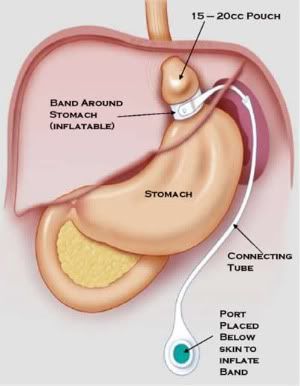
WLS Option #1: Lap-Band
Lap-Band reduces the amount of food you are able to consume in one setting without removal of any part of the stomach. This is accomplished through the insertion of a band around the top part of the stomach which creates a smaller stomach pouch for food. This makes you feel full faster and longer as the band also restricts how quickly food can progress from your stomach to the rest of your digestive system. For more information about the Lap-Band please visit Lapband.com.
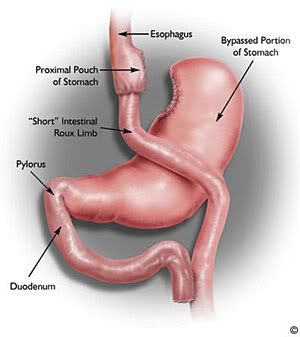
Gastric Bypass surgery reduces the size of the stomach through the surgical removal of a large portion of the stomach. It also involves a redirection of the small intestine which bypasses the upper portion of the small intestine. In addition to reducing the stomach size the surgical removal of the stomach reduces the production of the “hunger hormone” which controls appetite. This helps you to feel full longer and to process food longer. For more information about Gastric Bypass please visit Roux-En-Y Gastric Bypass on Webmd.com.
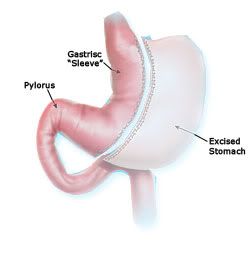
WLS Option #3: Gastric Sleeve *Jimmy's Surgery*
Gastric Sleeve surgery removes a large portion of the stomach but leaves all of the small intestine intact as is. This still reduces the production of the “hunger hormone” and creates a smaller holding area for food entering the stomach but it causes fewer nutrient absorption issues because the small intestine remains fully intact. For more information about Gastric Sleeve please visit Gastric Sleeve Surgery on thebariatricsurgeryresource.com.
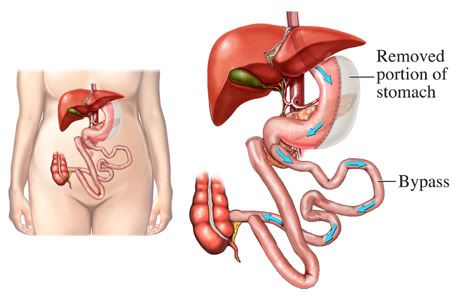
WLS Option #4: Gastric Bypass with a Doudenal Switch (Biliopancreatic Diversion with Duodenal Switch)
The Doudenal Switch is a weight loss surgery procedure that is composed of a restrictive and a malabsorptive aspect.
The restrictive portion of the surgery involves removing approximately 70% of the stomach along the greater curvature.
The malabsorptive portion of the surgery reroutes a lengthy portion of the small intestine, creating two separate pathways and one common channel. The shorter of the two pathways, the digestive loop, takes food from the stomach to the common channel. The much longer pathway, the biliopancreatic loop, carries bile from the liver to the common channel. The common channel is the portion of small intestine, usually 75-150 centimeters long, in which the contents of the digestive path mix with the bile from the biliopancreatic loop before emptying into the large intestine. The objective of this arrangement is to reduce the amount of time the body has to capture calories from food in the small intestine and to selectively limit the absorption of fat. As a result, following surgery, these patients only absorb approximately 20% of the fat they intake. This is copied directly from Wikipedia as I didn’t know how to summarize it myself. For more information about Duodenal Switch please visit Doudenal Switch on Wikipedia.org.
I hope this helps to make you aware of the kinds of Weight Loss Surgeries available. Please consult your doctor if you are considering WLS.
I realized when I was looking back at my last post that I talked about why obese people in general consider Weight Loss Surgery (WLS) but I didn’t talk specifically about Jimmy and me. So I wanted to stop and take you back...
Jimmy is 36 years old. He is 6’3” and a BIG guy. Many people can pinpoint the cause of their weight gain to a specific event or series of events in their lives. Jimmy once told me that he doesn’t remember a time when he wasn’t the “Big Kid”. I don’t think that could be easy on anyone.
Jimmy doesn’t believe there were any specific things in his life that caused him to gain weight (and of course there is the continuing genetics debate about weight) but that doesn’t mean his life was easy. He was raised by his amazingly wonderful grandparents--Grampy and Grammy--who lived in Boonville, MO.
Grampy and Grammy did their best to help Jimmy be healthy and active. He participated in just about every sport he was eligible to play. They made sure he ate his veggies (however few of them he may enjoy), and they took him to the doctor in the third grade when they were still concerned about his size. Nothing any of them did seemed to change the weight.
Jimmy says that it wasn’t until he had free reign over his diet and he could eat whatever he wanted that his weight truly escalated. Like most people in America, Jimmy didn’t make very healthy choices when it came to eating. By the time he really realized he had a real and serious weight problem things seemed hopeless to change.
I can attest from personal experience that when you can’t see a way out of your bad circumstances you often choose to continue in them instead of trying to make a way. So here we are now. It’s been 18 years since Jimmy left home to go to college and the spiral began and we are just now really, seriously trying to fight out way out of the pit. It’s going to be a long hard journey but we know in the end it will be worth all the blood, sweat, and tears.
I would hazard a guess that if you are reading this then you may have either had or be considering some kind of WLS. Therefore you are not the person that says “They can’t lose the weight because they are lazy” or “Why do surgery when you can lose it naturally” or “They are just looking for a ‘magic’ fix to their problem”. Those people DRIVE ME CRAZY! In some cases their questions might be valid but in the vast majority they are just wrong and their questions are inappropriate. Let me explain...
Most people are not aware that there have been medical studies conducted that have concluded that most morbidly obese people (anyone with a BMI 40+) are physically incapable of losing their weight naturally and keeping it off long term. These studies are the reason that insurance companies have decided to provide coverage for WLS surgeries such as the gastric bypass and Lap-Band. They realize that many of the people they insure will never be able to lose their excess weight without surgical assistance.
However, surgery never has and probably never will be an easy or magical fix. You MUST WORK to change your eating and exercise habits in order to receive the benefits of the surgery. “Failed” surgeries are the cause of many of the snide and demeaning comments like the examples I gave above. Really it is not the surgery that has failed but the people who have failed to commit to a lifestyle change that have failed to receive the results they were hoping to achieve. More on this later.
Jimmy and I decided to consider WLS because we realized that he needs help to achieve his weight loss goals. We are committed to making lifestyle changes that will make us healthier and will help to achieve and maintain long-term health and weight management. We are ready and willing to start putting in the work it will take to make those dreams happen. Join us!
This is the total weight lost since Jimmy first started his WLS journey in October 2011.
Here's the breakdown: Jimmy lost 15 LBS regularly, 44 LBS on his two week pre-op liquid diet, and the rest has been post-op weight loss.
Christiana's Weight Loss Ticker
Showing my support by taking the Pound Plunge! So here's my weight loss ticker too. I want to not only encourage Jimmy to keep doing great but I want to get in there right beside him and be healthier too.