Social Icons

Showing posts with label gastric bypass. Show all posts

Wednesday, October 31, 2012

022 Judy Shares About Why It's Important to Talk to Your Doctor

Salam and good evening to you worthy friend! Thanks for dropping by Jimmy Goes Gastric. Today I want to introduce you to a friend of mine. Her name is Judy. Judy and I have known each other since we were kids. We went to school together and played together. I remember the struggles that Judy's family went through when tragedy struck unexpectedly. Judy has been following our story here on Jimmy Goes Gastric and as a result she contacted me the other day to share some of her family's experience with WLS. After talking to her I asked if she would kindly share some of her story with everyone here, and she graciously agreed.

Please keep reading as Judy shares from her own personal experience why it is important to keep an open line of communication between you and your doctor when you are undergoing WLS.


Why It's Important to Talk to Your Doctor

Hi. My name is Judy. My family (two brothers, Mom, & Dad) lived in Fulton, Missouri, for most of my childhood.

My father died when I was just twelve years old. He died because of his obesity. My mother, who was also obese, was worried that she would die soon, as well if she didn't lose weight.

Mom dieted and exercised and still struggled with her weight. It was then that she decided to have gastric bypass. She was thrilled that she was accepted to have the surgery done. I remember her being worried for the actual surgery. She worried she wouldn't survive the procedure, but never worried about what would follow the surgery.

The surgery was a success, and the pounds began to melt away. She lost 150 pounds in no time. But her road was not easy. Everything she ate made her sick. Because I was so young I don't know if her doctors had prepared her for that, or if they had told her what to eat to keep her healthy and she just struggled with it.

I remember her eating cheese sticks all the time because that is all that she was able to keep down. Because she wasn't getting the nutrition she needed her blood sugar would drop and she would go into diabetic comas. Many times my brother called for an ambulance because she was incoherent and didn't know who we were.

The last time she went into a diabetic comma, she didn't wake up. After my mother died I was angry that she had had the surgery, but since I have come to understand that her obesity could have killed just like it had my father. I was blessed to have those six extra years with her.

I know this surgery can be life changing. I have seen many people who have had it done successfully. I would just like to encourage all those who are considering having this done to be well educated about this decision. Keep a close dialogue with your doctor before and after the surgery. Fill your life with people who can support you and help you through this journey. Nothing is more important than that!

Thanks for letting me share my story with you.

Judy

Monday, October 8, 2012

005 Insurance, Money and the Kitchen Sink

Last time we talked about the four main types of weight loss surgery (WLS) available. If you interest has been piqued then I am sure you are starting to wonder how much it’s going to cost you and what you may or may not have to do to get insurance coverage for a WLS. I can only answer these questions from our perspective and give you tips on how you can find out how these things are going to apply to you.

Let’s just go ahead and get the easy question out of the way...

Q: How much will a WLS cost me?

A: No one has an exact amount. It varies from person to person and hospital to hospital. However, for an estimate of the cost you will incur you should contact the WLS program/center/doctor you are planning to use. They should have a pretty good idea of how the money will come out in the end because they do this all the time.

Keep in mind that there are many factor that will determine the cost of your WLS:

• Surgeon performing the surgery
• Time spent recovering in the hospital
• Complications or lack of complications
• Number of care providers overseeing your case

Q: Will my medical insurance cover WLS?

A: Each insurance carrier is unique. Be sure to check with your insurance provider before undergoing surgery as the types of surgery covered and the requirements for coverage vary widely from one provider to the next. A good surgery program should help you to file your insurance paperwork and receive pre-authorization of coverage for your surgery before you ever schedule your operating room time.

Q: What are some common insurance requirements for WLS coverage?

A: I can’t tell you for sure about your insurance company but I can tell you about ours. But I am not going to do that until next time...

So stay tuned.


Friday, October 5, 2012

004 What kinds of Weight Loss Surgery (WLS) are Available?

WLS is pretty self-explanatory. It is a surgery that is a tool designed to help an individual lose weight. But you may be wondering what kinds of surgeries are out there. I am going to give you a brief explanation of the four surgeries that I am aware of, but remember that I am not a doctor. If you have any medical questions or concerns please consult your doctor.

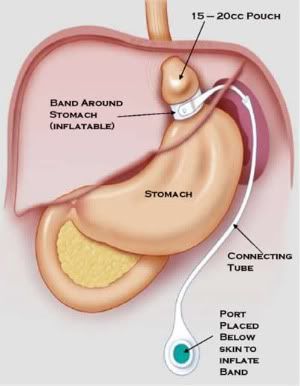
WLS Option #1: Lap-Band

Lap-Band reduces the amount of food you are able to consume in one setting without removal of any part of the stomach. This is accomplished through the insertion of a band around the top part of the stomach which creates a smaller stomach pouch for food. This makes you feel full faster and longer as the band also restricts how quickly food can progress from your stomach to the rest of your digestive system. For more information about the Lap-Band please visit Lapband.com.


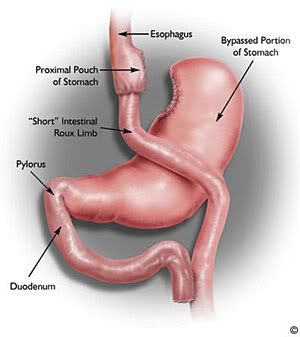
WLS Option #2: Gastric Bypass (Roux-En-Y Gastric Bypass)

Gastric Bypass surgery reduces the size of the stomach through the surgical removal of a large portion of the stomach. It also involves a redirection of the small intestine which bypasses the upper portion of the small intestine. In addition to reducing the stomach size the surgical removal of the stomach reduces the production of the “hunger hormone” which controls appetite. This helps you to feel full longer and to process food longer. For more information about Gastric Bypass please visit Roux-En-Y Gastric Bypass on Webmd.com.


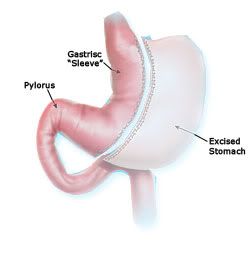
WLS Option #3: Gastric Sleeve *Jimmy's Surgery*

Gastric Sleeve surgery removes a large portion of the stomach but leaves all of the small intestine intact as is. This still reduces the production of the “hunger hormone” and creates a smaller holding area for food entering the stomach but it causes fewer nutrient absorption issues because the small intestine remains fully intact. For more information about Gastric Sleeve please visit Gastric Sleeve Surgery on thebariatricsurgeryresource.com.


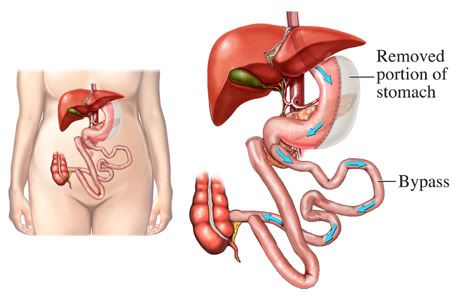
WLS Option #4: Gastric Bypass with a Doudenal Switch
(Biliopancreatic Diversion with Duodenal Switch)

The Doudenal Switch is a weight loss surgery procedure that is composed of a restrictive and a malabsorptive aspect. The restrictive portion of the surgery involves removing approximately 70% of the stomach along the greater curvature. The malabsorptive portion of the surgery reroutes a lengthy portion of the small intestine, creating two separate pathways and one common channel. The shorter of the two pathways, the digestive loop, takes food from the stomach to the common channel. The much longer pathway, the biliopancreatic loop, carries bile from the liver to the common channel. The common channel is the portion of small intestine, usually 75-150 centimeters long, in which the contents of the digestive path mix with the bile from the biliopancreatic loop before emptying into the large intestine. The objective of this arrangement is to reduce the amount of time the body has to capture calories from food in the small intestine and to selectively limit the absorption of fat. As a result, following surgery, these patients only absorb approximately 20% of the fat they intake. This is copied directly from Wikipedia as I didn’t know how to summarize it myself. For more information about Duodenal Switch please visit Doudenal Switch on Wikipedia.org.

I hope this helps to make you aware of the kinds of Weight Loss Surgeries available. Please consult your doctor if you are considering WLS.